

Why Privacy-Preserving AdTech Matters in 2026
In 2026, Privacy-Preserving AdTech is becoming an important part of the digital advertising ecosystem as businesses look for ways to personalize advertising without relying on unrestricted individual tracking. The traditional third-party-cookie model has faced growing privacy pressure, while browsers and advertising platforms have explored technologies that use aggregation, on-device processing, contextual signals, and first-party relationships. Google’s Privacy Sandbox work, for example, has included privacy-oriented APIs designed to support advertising without exposing individual browsing histories in the same way as third-party cookies Privacy AdTech Trends.
The important change is not simply the disappearance of one advertising technology. Instead, advertisers are gradually moving toward a broader privacy-first model in which useful audience information can be generated without building detailed profiles of every individual internet user.
Table of Contents
- Privacy-Preserving AdTech and the End of Third-Party Tracking
- Privacy-Preserving AdTech and On-Device Processing
- Privacy-Preserving AdTech and Interest-Based Advertising
- Privacy-Preserving AdTech and First-Party Data
- Privacy-Preserving AdTech and Contextual Advertising
- Privacy-Preserving AdTech and Measurement
- Privacy-Preserving AdTech and AI
- Privacy-Preserving AdTech and the Future of Digital Advertising
- Conclusion
Privacy-Preserving AdTech and the End of Third-Party Tracking
One of the biggest changes connected to Privacy-Preserving AdTech is the decline of third-party-cookie-based tracking. Third-party cookies have historically allowed advertising systems to recognize users across different websites, making it possible to build audiences and support forms of personalized advertising.

The advertising industry has increasingly searched for alternatives that provide useful targeting while reducing the ability to follow individuals across unrelated websites. Google’s Privacy Sandbox initiative was designed around this challenge, with APIs intended to support advertising use cases while improving privacy and user control Privacy AdTech Trends.
This transition is creating opportunities for smaller privacy-focused technologies and advertising strategies. Instead of relying on one identifier, modern advertising systems can combine contextual information, first-party signals, aggregated measurement, and privacy-enhancing technologies.
Privacy-Preserving AdTech and Changing User Expectations
Users are also becoming more aware of how online advertising works. Privacy is no longer only a technical issue for browsers and advertising companies. People increasingly expect greater transparency about why they see particular advertisements and what information is being used Privacy AdTech Trends.
This means future advertising systems need to consider both performance and user control. A system that provides relevant advertising while reducing unnecessary individual tracking can potentially address both concerns.
Privacy-Preserving AdTech and On-Device Processing
On-device processing is another important area within Privacy-Preserving AdTech. Instead of sending every piece of behavioral information to a central advertising server, some information can be processed locally on a user’s device.
Google’s earlier FLoC proposal demonstrated this general concept by placing users into interest-based cohorts through browser-side processing rather than sending individual browsing histories to an external server. However, FLoC was later replaced by the Topics API, which represented a different implementation of privacy-focused interest-based advertising Privacy AdTech Trends.
The broader idea remains important: useful advertising signals can potentially be generated closer to the user while limiting the amount of raw behavioral information that leaves the device.
Privacy-Preserving AdTech and Edge AI
As edge AI becomes more capable, local devices can process increasingly sophisticated information. This could allow advertising systems to use privacy-conscious signals without constantly transferring detailed user activity to centralized databases Privacy AdTech Trends.
However, local processing does not automatically guarantee privacy. The design of the system, the information shared, retention periods, user controls, and potential re-identification risks all remain important.
Privacy-Preserving AdTech and Interest-Based Advertising
Interest-based advertising is a major challenge for Privacy-Preserving AdTech because advertisers still want to reach people who may be interested in particular products or services.
The older approach often depended heavily on individual-level identifiers. Newer privacy-oriented approaches can instead use broader categories or aggregated signals. Google’s Topics proposal, for example, was designed so that a browser could determine a limited selection of broad interests based on recent browsing activity and share selected topics with participating sites rather than exposing the complete browsing history.
This illustrates a broader shift from asking, “Who exactly is this person?” toward asking, “What general type of content or product might be relevant to this audience Privacy AdTech Trends.
That distinction can reduce the need for detailed individual profiles while still giving advertisers useful audience information.
Privacy-Preserving AdTech and First-Party Data
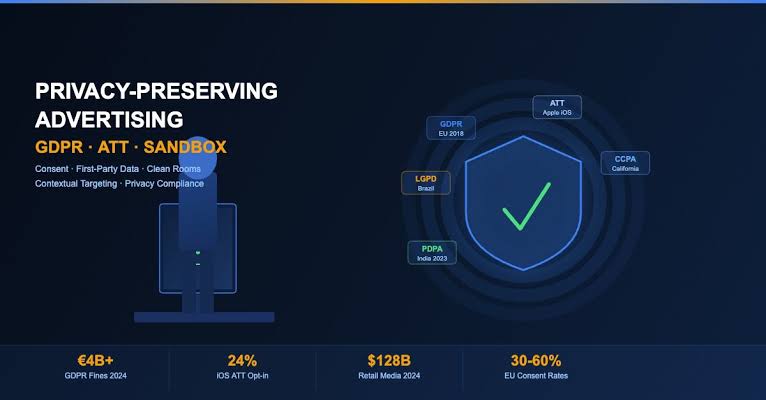
First-party data is becoming increasingly important in Privacy-Preserving AdTech. First-party data comes from direct interactions between a business and its customers, such as information collected through a company’s website, app, account system, or loyalty program.
Unlike third-party tracking, these relationships can provide businesses with information directly connected to their own customer interactions. Google has also emphasized first-party relationships as an important part of advertising in a privacy-focused ecosystem.
For marketers, this changes the importance of building direct relationships with audiences. A company that provides useful content, products, services, or membership experiences can develop consent-based customer relationships rather than depending entirely on external tracking systems Privacy AdTech Trends.
Privacy-Preserving AdTech and Customer Trust
Trust can become an important competitive factor in this environment. When customers understand why data is collected and how it is used, they may be more comfortable interacting with a brand.
The goal is not simply to collect less data. It is also to make data practices more understandable, controlled, and appropriate for the purpose for which information is collected.
Privacy-Preserving AdTech and Contextual Advertising
Contextual advertising is another important part of Privacy-Preserving AdTech because it can work without requiring detailed information about a specific person’s browsing history.
For example, an advertisement for running shoes can appear next to an article about marathon training because the content itself suggests a relevant context. The advertising system does not necessarily need to know the reader’s complete activity across the internet Privacy AdTech Trends.
This approach is particularly interesting because it connects advertisements with the environment in which they appear rather than depending entirely on individual tracking.
Modern advertising strategies can also combine contextual signals with first-party information and aggregated measurement. Google has reported testing privacy-preserving signals that included contextual information alongside other signals rather than relying on a single replacement for third-party cookies.
Privacy-Preserving AdTech and Conversion Measurement
Measuring advertising performance is one of the most difficult challenges in Privacy-Preserving AdTech. Advertisers still need to understand whether campaigns generate useful results, but detailed user-level tracking can create privacy concerns.
Privacy-focused measurement approaches therefore aim to provide aggregated information about campaign performance rather than exposing the complete journey of every individual user Privacy AdTech Trends.
This can change how marketers analyze campaigns. Instead of tracking one person from advertisement to website to purchase across multiple platforms, systems can increasingly focus on broader statistical signals that show whether advertising generated meaningful results.
The trade-off is that measurement can become less granular. Advertisers may have less individual-level information but gain a model that relies more heavily on aggregated and privacy-conscious data Privacy AdTech Trends.
Privacy-Preserving AdTech and AI
Artificial intelligence is adding another layer to Privacy-Preserving AdTech. AI can help advertising platforms analyze contextual information, classify content, predict broad audience interests, optimize campaigns, and detect suspicious advertising activity.

At the same time, AI systems can create privacy risks if they are trained or operated using excessive personal information. This makes data minimization and careful governance increasingly important Privacy AdTech Trends.
The future of AI-powered advertising may therefore involve more emphasis on privacy-preserving inputs, aggregated signals, local processing, and controlled data environments. AI can improve advertising efficiency, but the quality of the privacy architecture surrounding it remains critical.
Privacy-Preserving AdTech: Comparing the New Advertising Models
| Advertising Approach | Main Signal | Privacy Direction | Main Challenge |
|---|---|---|---|
| Third-Party Cookies | Cross-site identifiers | Lower | Individual tracking |
| Contextual Advertising | Page content | Higher | Less behavioral detail |
| First-Party Data | Direct customer relationship | Higher when properly governed | Requires customer trust |
| On-Device Signals | Local processing | Potentially higher | Technical complexity |
| Interest-Based Topics | Broad interest categories | Higher than individual tracking | Limited granularity |
| Aggregated Measurement | Statistical results | Higher | Less individual attribution |
| AI-Assisted AdTech | Multiple signals | Depends on design | Data governance |
The table shows why Privacy-Preserving AdTech is not one single technology. It is a broader approach involving multiple methods that can reduce dependence on individual-level tracking Privacy AdTech Trends.
Privacy-Preserving AdTech Trends at a Glance
The following conceptual graph illustrates the different areas shaping the privacy-focused advertising ecosystem. It is not a market-size forecast; it is a visual representation of the relative emphasis of the technologies discussed in this article Privacy AdTech Trends.
Privacy-Preserving AdTech and the Future of Digital Advertising
The future of Privacy-Preserving AdTech will probably involve a combination of technologies rather than one universal replacement for third-party cookies. Contextual advertising, first-party relationships, on-device processing, aggregated measurement, and privacy-focused APIs can all contribute to a more privacy-conscious advertising ecosystem Privacy AdTech Trends.
The history of FLoC also demonstrates why this market is still evolving. FLoC was publicly presented as a cohort-based alternative to individual tracking, but Google later replaced the proposal with Topics Privacy AdTech Trends.
This evolution shows that privacy-focused advertising technology must balance several competing requirements. Users want privacy and control, publishers need sustainable revenue, and advertisers need measurable results.
As these technologies develop, advertisers may increasingly compete on the quality of their first-party relationships, creative content, contextual relevance, and measurement strategies rather than simply on how much individual behavioral data they can collect.
Privacy-Preserving AdTech and Better Digital Privacy
Another important feature of Privacy-Preserving AdTech is that privacy and advertising performance do not necessarily have to be treated as completely opposite goals. Google’s published testing, for example, found that a broader combination of privacy-preserving signals showed promise for interest-based advertising, although the experiment did not compare third-party cookies against the Topics API alone Privacy AdTech Trends.
This distinction is important because privacy technology should be evaluated using real-world evidence rather than assumptions. Different advertising environments, audiences, browsers, regulations, and campaign objectives can produce different results.
For businesses, the practical direction is increasingly clear: understand what data is genuinely necessary, strengthen direct customer relationships, and build measurement systems that provide useful insights without unnecessarily exposing individual behavior Privacy AdTech Trends.
Conclusion: Privacy-Preserving AdTech Is Reshaping Advertising
Privacy-Preserving AdTech represents a major shift in how digital advertising can work in a privacy-conscious environment. The industry is moving away from dependence on individual cross-site tracking and exploring alternatives such as contextual advertising, first-party data, on-device processing, aggregated measurement, and privacy-focused APIs Privacy AdTech Trends.
FLoC itself is no longer the current solution, having been replaced by Google’s Topics proposal, but its underlying cohort-based idea helped demonstrate the broader direction toward less individualized advertising.
In 2026, the most important change is therefore not simply the disappearance of a cookie. It is the development of a broader advertising model where relevance, measurement, technology, and privacy must work together. For advertisers and publishers, adapting to this environment means focusing more on trusted relationships, useful content, responsible data practices, and privacy-conscious technology Privacy AdTech Trends.
 administratoir16