
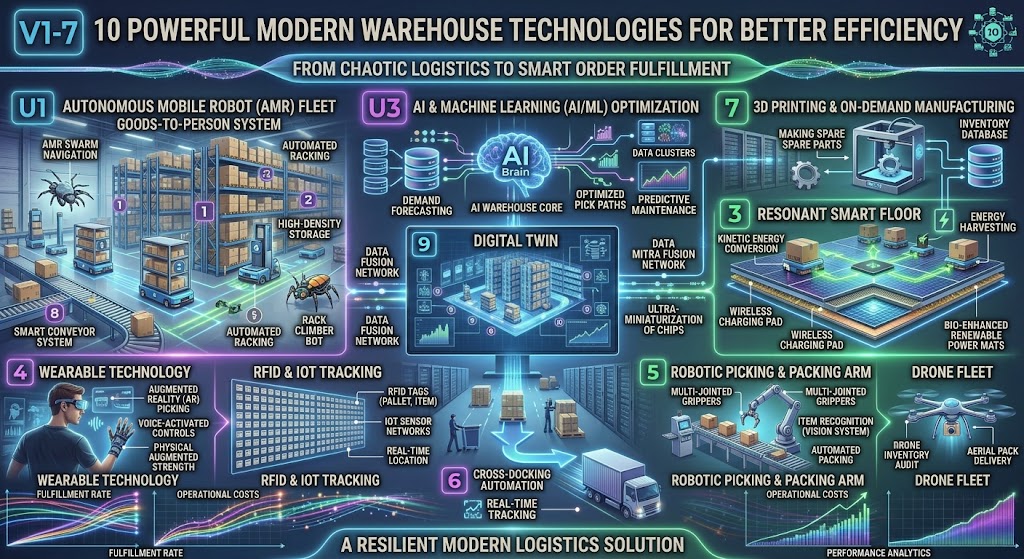
Modern Warehouse Technologies are changing how products are stored, tracked, moved, and delivered. Traditional warehouses once depended heavily on manual labor, paper-based processes, and basic equipment. Today, advanced software, sensors, robotics, automation, computer vision, and intelligent systems are helping warehouses operate faster and with greater accuracy.
The growth of online shopping and increasingly complex supply chains has created new demands for warehouse operations. Businesses need to process large numbers of orders while reducing delays and improving inventory visibility. Modern Warehouse Technologies are helping address these challenges by connecting physical warehouse operations with digital systems.
Table of Contents
- AI-Powered Warehouse Management
- Autonomous Mobile Robots
- Automated Storage and Retrieval Systems
- Computer Vision
- RFID Tracking
- Smart Warehouse Sensors
- Automated Sorting Systems
- Digital Twins
- Drones for Inventory Management
- Predictive Warehouse Analytics
- The Future of Modern Warehouse Technologies
1. AI-Powered Warehouse Management
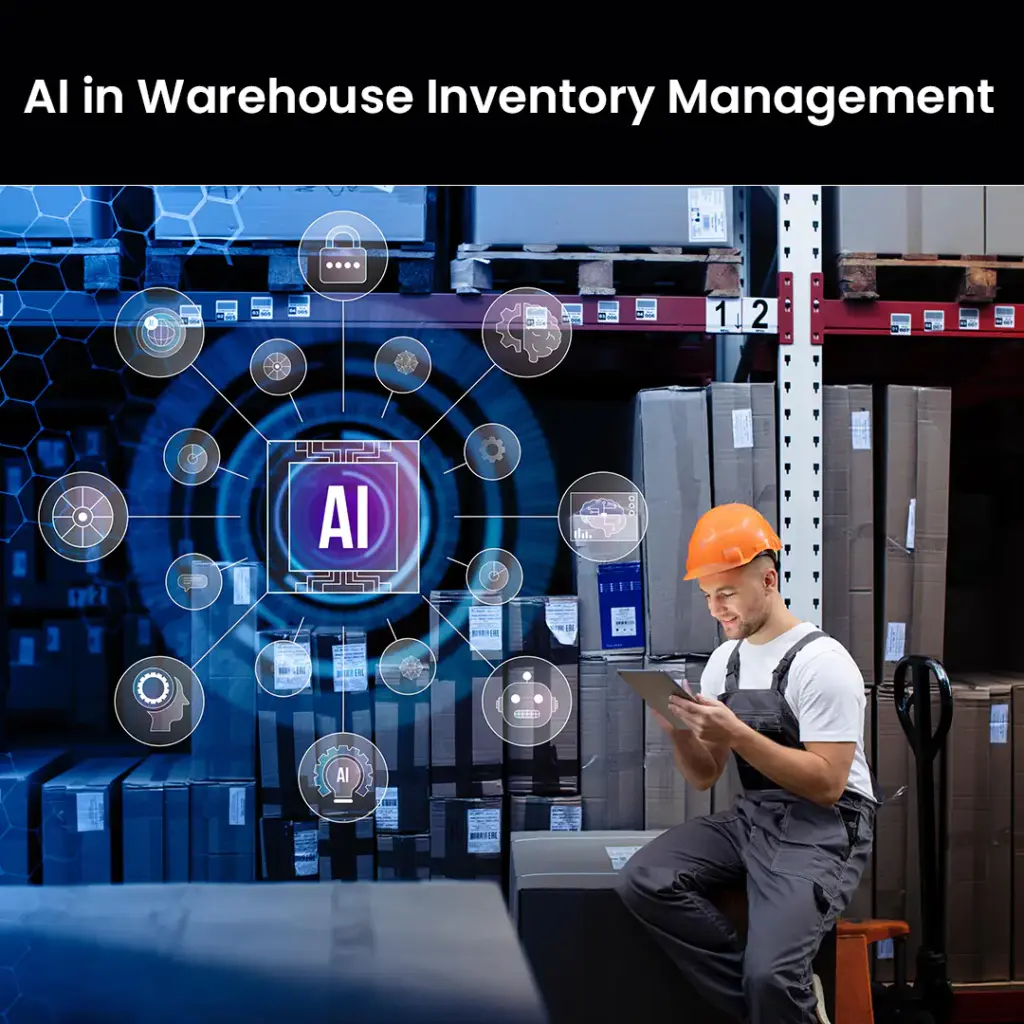
Artificial intelligence is becoming an important part of Modern Warehouse Technologies. AI-powered warehouse management systems can analyze information about inventory, orders, product movement, and warehouse activity.
Instead of relying entirely on manual decisions, intelligent software can help determine how products should be stored, where frequently requested items should be positioned, and how warehouse resources can be organized.
How Modern Warehouse Technologies Improve Decisions
A warehouse can generate huge amounts of operational data every day. AI systems can analyze this information and identify patterns that may not be immediately obvious to human operators.
This can help businesses make more informed decisions about inventory management, staffing, order processing, and warehouse organization.
2. Autonomous Mobile Robots
Autonomous mobile robots are another major development among Modern Warehouse Technologies. These robots can move around warehouses and transport products, shelves, containers, or other materials.
Unlike traditional fixed conveyor systems, mobile robots can potentially navigate changing warehouse layouts and adjust their routes according to operational requirements.
Robots Working Alongside People
Warehouse robots do not necessarily need to replace human workers. In many systems, robots are designed to handle repetitive transportation tasks while people focus on activities that require judgment, problem-solving, or specialized skills.
This combination can create a more flexible warehouse environment.
3. Automated Storage and Retrieval Systems
Automated storage and retrieval systems, often called ASRS, use automated equipment to store and retrieve products from designated locations.
These systems can make better use of vertical warehouse space while reducing the amount of manual movement required to locate inventory.
Smarter Use of Warehouse Space
Space is one of the most important resources inside a warehouse. Modern Warehouse Technologies such as automated storage systems can help businesses organize products more efficiently and potentially increase storage capacity without simply expanding the building.
4. Computer Vision
Computer vision allows machines to analyze images and video using cameras and specialized software. In warehouses, this technology can be used to identify products, inspect packages, monitor processes, and detect certain operational problems.
Instead of depending entirely on barcode scanning or manual inspection, computer vision can provide an additional layer of automated observation.
Visual Intelligence in Modern Warehouse Technologies
A warehouse equipped with cameras and computer vision systems can continuously monitor certain processes. This may help identify misplaced products, damaged packages, incorrect items, or unusual activity.
As computer vision technology improves, its role in warehouse automation could become even more important.
5. RFID Tracking
Radio-frequency identification, or RFID, uses electronic tags and readers to identify and track objects. It is another useful technology within Modern Warehouse Technologies.
Unlike traditional barcode systems, RFID can allow multiple tagged objects to be detected without requiring every individual tag to be directly visible to a scanner.
Better Inventory Visibility
Accurate inventory information is essential for modern supply chains. RFID can help businesses maintain better visibility into where products are located and when they move through different parts of a warehouse.
This can reduce dependence on manual inventory checks in some operations.
6. Smart Warehouse Sensors
Sensors are becoming increasingly important in connected warehouses. Temperature sensors, motion sensors, weight sensors, location systems, and environmental monitoring devices can collect information about warehouse conditions and equipment.
These sensors can connect physical warehouse activity with digital monitoring systems.
Real-Time Monitoring
Imagine a warehouse where sensors continuously monitor temperature, equipment activity, product movement, and storage conditions. Managers can receive information about important changes without having to inspect every area manually.
This is one reason sensor networks are becoming an important part of Modern Warehouse Technologies.
7. Automated Sorting Systems
Automated sorting systems are designed to identify products or packages and direct them toward the appropriate destination.
High-speed sorting can be especially useful in warehouses that process large numbers of orders. Instead of having workers manually determine where every package should go, automated systems can handle much of the repetitive sorting process.
Faster Order Processing
As online orders increase, warehouses need to move products through different stages quickly. Automated sorting can help organize packages according to destination, order type, carrier, or other operational requirements.
This can make the overall workflow more consistent and scalable.
8. Digital Twins
Digital twins create virtual representations of physical systems. In a warehouse environment, a digital twin can represent the building, equipment, inventory flows, and operational processes.
Businesses can use digital models to understand how changes could affect warehouse performance before making those changes in the physical environment.
Testing Warehouse Changes Digitally
For example, a company could simulate a new storage arrangement or workflow and examine how it might influence movement and efficiency.
This makes digital twins an interesting part of Modern Warehouse Technologies, especially for large and complex facilities.
9. Drones for Inventory Management
Drones are being explored for certain warehouse inventory tasks. Equipped with cameras, scanners, or other sensors, drones can potentially move through large storage areas and collect information from locations that may be difficult or time-consuming for workers to inspect manually.
This could be particularly useful in warehouses with tall storage racks.
Automated Inventory Checks
Instead of requiring workers to repeatedly climb or move around large storage areas, drones could assist with automated inventory data collection.
The technology still has practical limitations, including safety, navigation, regulations, and integration with warehouse systems, but it represents an interesting direction for future warehouse automation.
10. Predictive Warehouse Analytics
Predictive analytics uses historical and real-time information to identify patterns and estimate what could happen next. In warehouses, this can involve predicting inventory demand, equipment maintenance requirements, order volumes, and workflow problems.
This makes predictive analytics another important component of Modern Warehouse Technologies.
Preventing Problems Before They Grow
If data suggests that a piece of equipment may require maintenance, warehouse operators may be able to investigate it before a major failure occurs.
Similarly, demand forecasting can help businesses prepare inventory and resources for periods of higher activity.
The Future of Modern Warehouse Technologies
The future of Modern Warehouse Technologies will likely involve greater integration between software, machines, sensors, robotics, and human workers. Instead of operating as separate tools, these technologies can increasingly communicate through connected warehouse platforms.
Artificial intelligence could coordinate workflows, robots could transport goods, computer vision could monitor operations, sensors could collect real-time information, and digital twins could help businesses test changes before implementing them.
However, advanced warehouse technology also comes with challenges. Businesses need to consider installation costs, cybersecurity, maintenance, worker training, system compatibility, and the changing roles of employees.
The goal is not simply to add more technology. Successful warehouse modernization depends on choosing technologies that solve genuine operational problems and work effectively together.
Conclusion
Modern Warehouse Technologies are transforming warehouses from mostly physical storage spaces into connected and increasingly automated environments. AI, autonomous robots, automated storage systems, computer vision, RFID, smart sensors, sorting systems, digital twins, drones, and predictive analytics each offer different ways to improve warehouse operations.
As supply chains become more complex and customer expectations continue to evolve, technology will play an increasingly important role in how warehouses manage products and information. The most effective future warehouses may be those that combine intelligent software, automation, real-time data, and human expertise into one coordinated system.