
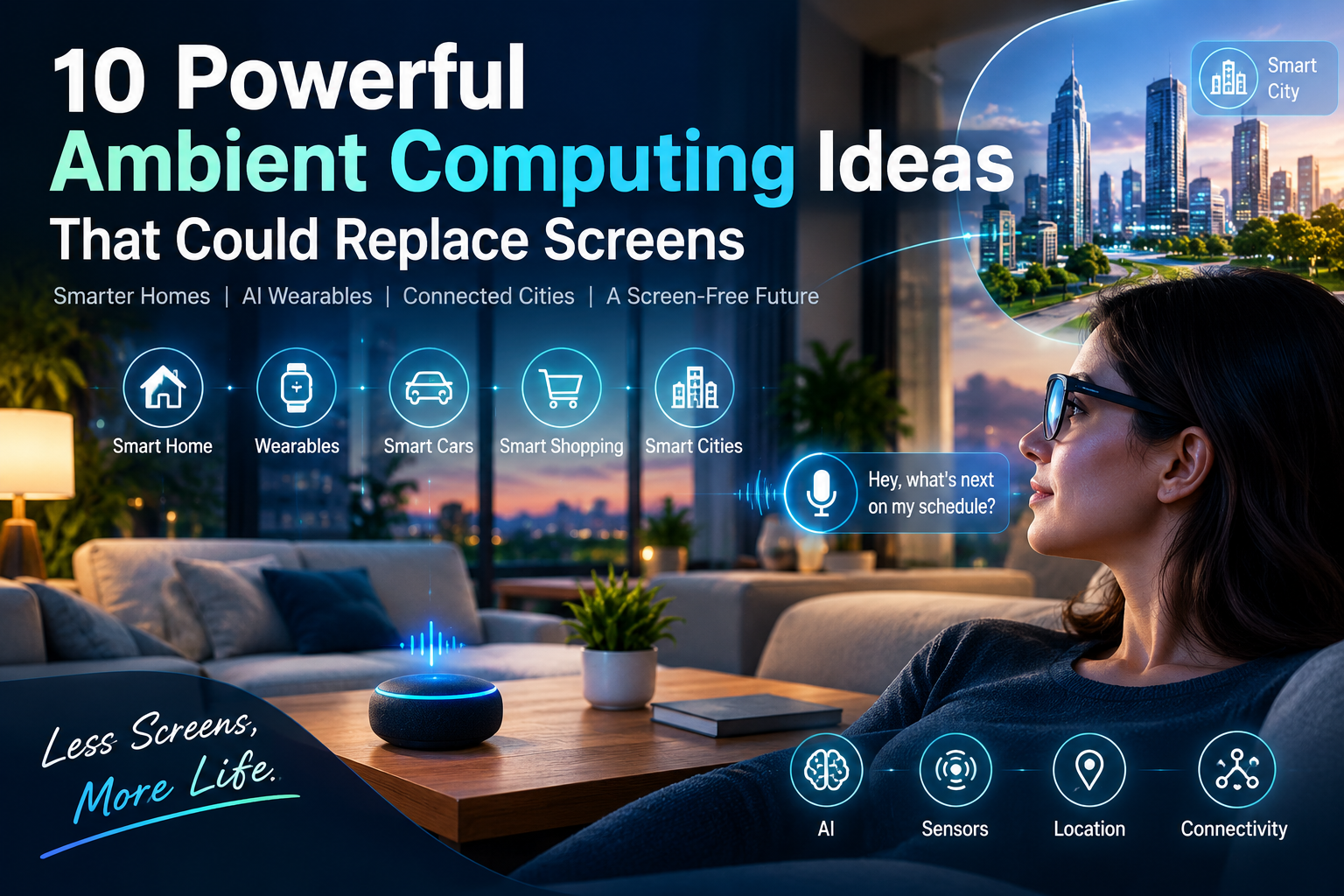
Ambient Computing is becoming an interesting direction in modern technology because it focuses on making digital services available without requiring people to constantly look at a phone, computer, or traditional display. Instead of interacting with technology through screens, users can communicate with devices through voice, sensors, gestures, location awareness, and artificial intelligence. As these technologies develop, Ambient Computing could change how people work, communicate, shop, travel, and control their surroundings.
The idea is not simply about removing screens. It is about making technology work quietly in the background while responding to what people need. Smart homes, wearable devices, connected environments, intelligent vehicles, and AI assistants are already moving toward this approach. In the future, some everyday tasks may happen automatically without users opening an app or touching a screen.
Table of Contents
What Is Ambient Computing?
How Ambient Computing Could Reduce Screen Use
10 Powerful Ambient Computing Ideas
Benefits and Challenges of Ambient Computing
The Future of Ambient Computing
What Is Ambient Computing?
Ambient Computing refers to technology that becomes integrated into the environment instead of requiring constant direct interaction. Devices can use sensors, artificial intelligence, microphones, cameras, location systems, and connected networks to understand situations and respond to users.

Traditional technology usually requires a person to open an application, press a button, or read information from a screen. Ambient Computing attempts to make these interactions more natural. A room could automatically adjust its temperature, a vehicle could provide directions through audio, or a wearable device could deliver important information without requiring the user to check a phone.
Why Ambient Computing Is Becoming Important
The growth of artificial intelligence, smart sensors, edge computing, and connected devices is making Ambient Computing more practical. Technology can now process more information from its surroundings and respond faster to changing situations.
Instead of adding another screen to everyday life, developers are increasingly exploring ways to make technology less noticeable while still useful.
How Ambient Computing Could Reduce Screen Use
The biggest potential of Ambient Computing is reducing the number of situations where people need to interact with traditional displays. Voice assistants can already answer questions without requiring a search screen, while smart devices can automatically react to movement, sound, temperature, and location.
Future systems could combine these technologies so that users receive information in more natural ways. Audio, wearable feedback, smart lighting, spatial signals, and automated actions could become alternatives to constantly checking screens.
10 Powerful Ambient Computing Ideas
1. Screen-Free Smart Homes
One of the most practical Ambient Computing ideas is the screen-free smart home. Instead of controlling every device through a smartphone application, connected systems could understand routines and automatically manage lighting, temperature, security, and appliances.
For example, lights could adjust when someone enters a room, while heating or cooling systems could respond to occupancy and environmental conditions. Voice and gesture controls could provide additional interaction when manual control is needed.
Smarter Home Automation
The goal would be to make the home respond naturally rather than forcing users to manage every device manually.
2. AI Wearables Instead of Phone Checking
Wearable technology could become an important part of Ambient Computing. Smart glasses, earbuds, rings, watches, and other compact devices can provide information without requiring users to pull out a smartphone.
An AI wearable could provide directions, reminders, translations, or notifications through audio or subtle visual and tactile feedback. This could reduce the need to repeatedly check a phone during everyday activities.
3. Intelligent Cars With Less Screen Interaction
Modern vehicles already contain large digital displays, but Ambient Computing could change how drivers interact with them. Instead of searching through menus, drivers could use natural voice commands, gestures, or contextual controls.

A vehicle could recognize that a driver needs navigation, adjust settings according to the journey, and provide important information through audio. The objective would be to reduce unnecessary interaction with dashboard screens.
Context-Aware Driving
Future systems could combine vehicle sensors, navigation information, and AI to provide relevant assistance at the appropriate moment.
4. Screen-Free Shopping Experiences
Retail environments could also use Ambient Computing to reduce traditional screen interactions. Smart shelves, sensors, digital identification systems, and intelligent checkout technologies could make shopping more automated.
Customers could potentially receive product information through wearable devices or voice-based systems instead of repeatedly scanning QR codes or searching on phones.
This could create shopping environments where technology operates quietly in the background.
5. Smart Offices That Understand Workers
The workplace is another area where Ambient Computing could become useful. Connected offices could automatically adjust lighting, temperature, meeting-room settings, and other environmental features based on occupancy and activity.
Instead of opening different applications to control workplace systems, employees could interact through voice, presence, or simple gestures.
Ambient Workplace Assistance
AI systems could also provide reminders or relevant information when needed without requiring employees to constantly monitor another screen.
6. Healthcare Without Constant Screen Interaction
Healthcare technology could benefit from Ambient Computing through sensors and wearable devices. Instead of manually entering every piece of information, connected systems could collect certain data automatically when appropriate.
For example, wearable devices could monitor selected health-related measurements and transmit information to authorized systems. In clinical environments, ambient technologies could also help reduce some repetitive documentation tasks.
The implementation would need strong privacy, security, accuracy, and consent protections.
7. Smart Cities With Invisible Technology
Ambient Computing could eventually become part of smart-city infrastructure. Sensors could monitor traffic conditions, energy usage, environmental conditions, parking availability, and other systems.
Citizens would not necessarily need to interact with a screen for every service. Information could be delivered through connected vehicles, public infrastructure, audio systems, or personal devices when relevant.
Connected Urban Environments
The broader concept is to create environments where digital services respond to real-world conditions rather than requiring constant manual interaction.
8. Voice and Gesture-Based Communication
Voice and gestures could become major interfaces in a more ambient digital world. Instead of tapping through menus, users could ask for information or perform actions naturally.
Advances in AI could allow systems to understand context more effectively, while sensors could detect specific gestures. Together, these technologies could make interaction feel less dependent on traditional interfaces.
9. Ambient Learning and Education
Education could also use Ambient Computing to create more interactive learning environments. Classrooms could use sensors, audio systems, connected objects, and AI tools to provide contextual information.
Students might interact with educational systems through voice, physical objects, or immersive environments rather than relying entirely on computer screens.
More Natural Learning
The technology could support learning activities while allowing students to focus more on physical interaction, discussion, experiments, and collaboration.
10. AI Environments That Predict Everyday Needs
Perhaps the most advanced Ambient Computing idea is an environment that understands context and anticipates certain needs. Instead of waiting for a command, an intelligent system could recognize patterns and offer relevant assistance.
For example, a connected environment might remind someone about an upcoming appointment, prepare a preferred setting, or provide useful information based on time and location.
However, predictive technology would need clear controls so users can decide what information is collected and which automated actions are allowed.
Benefits of Ambient Computing
Ambient Computing could make technology more convenient by reducing repetitive interactions. People may spend less time searching through applications, changing settings, and checking screens for simple information.
Another potential benefit is accessibility. Voice, audio, gesture, and other interaction methods may provide alternatives for people who find traditional interfaces difficult to use.
Ambient systems could also improve automation because connected devices can respond to real-world conditions rather than waiting for manual instructions.
Challenges of Ambient Computing
The expansion of Ambient Computing also creates important challenges. Privacy is one of the biggest concerns because many ambient systems depend on sensors, microphones, cameras, location information, or behavioral data.
Security is another major issue. When more devices become connected, protecting those systems from unauthorized access becomes increasingly important.
There is also the question of control. Technology that automatically makes decisions should provide users with understandable settings, permissions, and ways to override automated actions.
Privacy and User Control
For Ambient Computing to become widely trusted, people need meaningful control over what devices can sense, what data is stored, how information is processed, and when automated systems can act.
The Future of Ambient Computing
The future of Ambient Computing may not mean that screens disappear completely. Instead, screens could become one of several available interfaces rather than the main way people interact with technology.
Phones, computers, tablets, smart glasses, vehicles, homes, and wearable devices could work together through AI and connected sensors. Many simple interactions could happen through voice, gestures, automation, or contextual responses.
As artificial intelligence and sensor technology continue developing, Ambient Computing could gradually make digital technology less visible while making digital services more integrated into everyday environments.
Conclusion
Ambient Computing represents a shift from technology that demands attention toward technology that can operate more naturally around people. Screen-free smart homes, AI wearables, intelligent vehicles, smart workplaces, healthcare systems, and connected cities are examples of how this concept could develop.
The biggest change may not be the disappearance of screens but the emergence of more flexible ways to interact with technology. If privacy, security, transparency, and user control are handled responsibly, Ambient Computing could become an important part of the next generation of digital experiences.
[…] flexible electronics and medical devices to automotive components and smart architecture, Shape-Shifting Materials could make future products more adaptable, compact, and efficient. These materials are still […]