
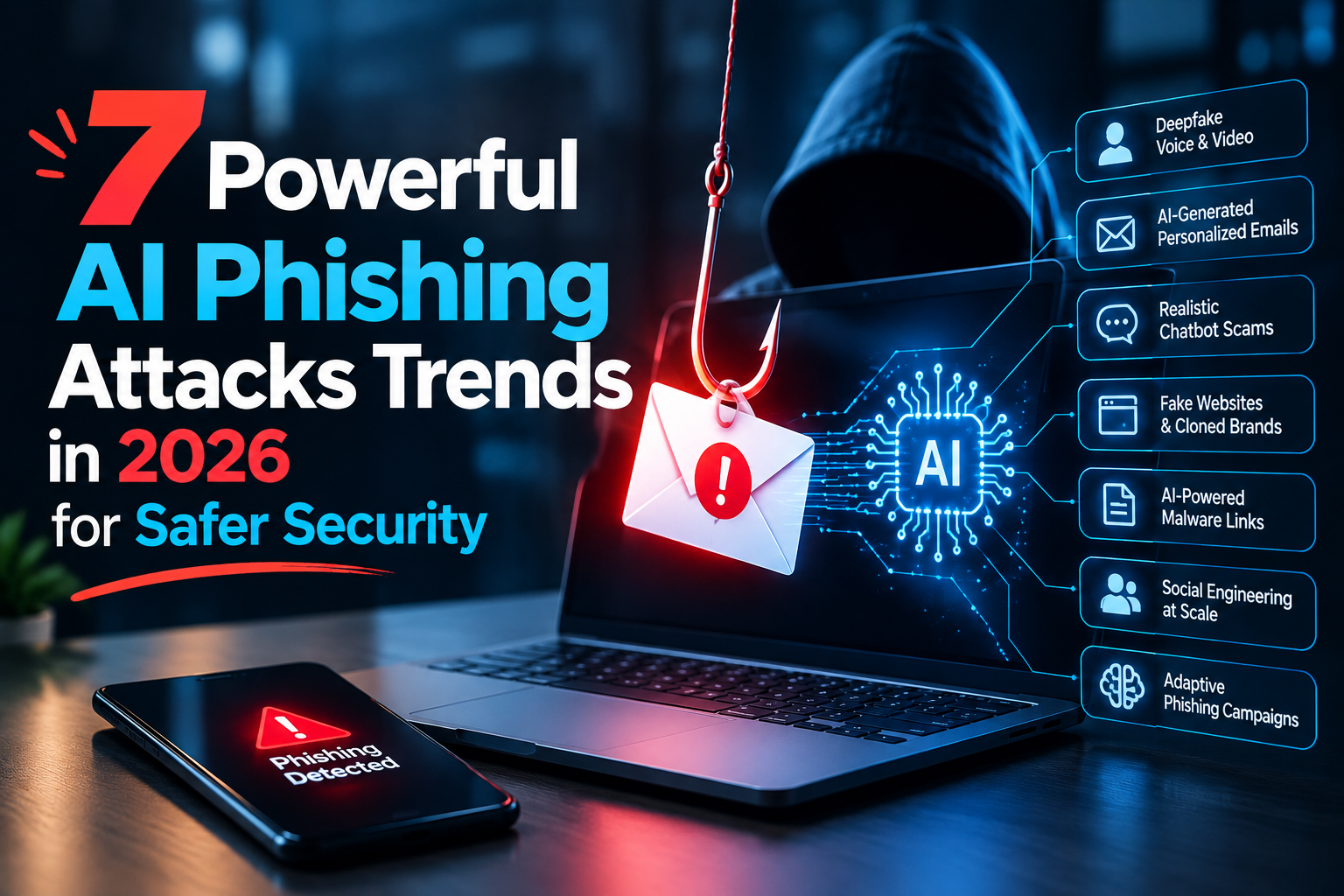
AI Phishing Attacks are changing the way cybercriminals manipulate people in 2026. Traditional phishing emails often contained obvious spelling mistakes, strange links, or generic messages, making them easier to recognize. Today, artificial intelligence can help attackers create highly personalized messages, imitate familiar communication styles, generate convincing voice impersonation, and adapt scams to the information available about a target. Recent cybersecurity research describes AI as increasing the scale, personalization, and credibility of social-engineering attacks.
The old “Nigerian Prince” style of scam is no longer the only model people need to worry about. Modern AI Phishing Attacks can look like ordinary workplace communication. A message may mention a real project, imitate a manager’s writing style, or arrive through a familiar communication platform. The goal is not necessarily to make the victim believe something completely unbelievable. Instead, attackers try to make a fraudulent request feel normal enough that the target acts without carefully verifying it.
Table of Contents
This article explains how AI Phishing Attacks are evolving in 2026, why personalization makes them more convincing, how voice cloning and deepfakes increase the risk, why traditional warning signs are becoming less reliable, and what organizations and individuals can do to strengthen security.
AI Phishing Attacks Are Becoming Highly Personalized
One of the biggest changes in AI Phishing Attacks is personalization. Artificial intelligence can process publicly available information and help attackers create messages that appear relevant to a specific person or organization. Social profiles, company websites, public posts, professional information, and previously exposed data can provide useful context for a scam.
Instead of sending thousands of identical emails, attackers can create messages that appear to understand the target’s role. A finance employee might receive a fake payment request referring to a real supplier. A developer could receive a message about a genuine software project. A manager might receive a document request that appears connected to an ongoing business discussion.
Research published in 2026 describes LLM-assisted phishing as accelerating and automating parts of phishing-related processes, while security organizations have reported increasingly personalized social-engineering campaigns.
AI Phishing Attacks Can Mimic Writing Styles
AI can also make fraudulent communication sound more natural. Traditional phishing often depended on awkward wording or obvious grammar problems. Modern AI-generated text can remove many of those clues.
An attacker may study how an executive communicates and then create a message using similar language, sentence structure, and level of formality. This makes the message harder to dismiss simply because it “doesn’t sound right.”
However, realistic writing is not proof of authenticity. A polished message can still contain a malicious link, fraudulent payment request, fake login page, or dangerous attachment.
AI Phishing Attacks Are Moving Beyond Email
Another major development is the movement from email-only phishing toward multi-channel social engineering. Attackers can combine email, messaging platforms, phone calls, fake websites, and other communication channels into one campaign.
Check Point’s 2026 research describes social engineering as expanding across phone calls, messaging applications, workplace tools, fake websites, and live impersonation.
This creates a serious problem because victims may receive several messages that appear to support the same story. For example, an employee could first receive an email about an account problem, followed by a chat message from a supposed IT employee, and then a phone call reinforcing the same request.
The communication may feel legitimate because different channels appear to confirm one another. In reality, the entire sequence can be controlled by the attacker.
AI Phishing Attacks and Voice Cloning
Voice cloning has become another important part of AI Phishing Attacks. A familiar voice has traditionally been a powerful trust signal. People may naturally feel more comfortable when they hear someone who sounds like a manager, colleague, family member, or business partner.
AI-generated voice technology weakens that assumption.
In 2026, security researchers have documented voice-based fraud services and AI-assisted voice impersonation. Check Point’s 2026 AI Security Report describes automated voice agents being used in credential-theft scenarios, while recent reporting has also highlighted the increasing use of AI voice cloning in scams.
AI Phishing Attacks Can Impersonate Trusted People
Imagine receiving a voice message that appears to come from your manager. The message refers to a project you actually worked on and asks you to open a confidential document.

The voice may sound convincing, but voice recognition alone should not be treated as identity verification.
A safer approach is to verify unusual requests through a separate trusted channel. If a request involves passwords, authentication codes, money, sensitive documents, or privileged access, independently confirm who made the request before taking action.
AI Phishing Attacks and Deepfake Video
Deepfake technology adds another layer to social engineering. Attackers can use synthetic or manipulated video to create the appearance of a real person participating in a conversation.
This is particularly concerning for organizations that rely heavily on video meetings. A person appearing on a screen is no longer automatic proof of identity.
Check Point’s 2026 report describes the increasing use of deepfake video and notes that remote identity signals such as voices, faces, documents, and live interactions can no longer stand alone as reliable proof of identity.
AI Phishing Attacks Can Exploit Familiarity
The danger of deepfake communication is not simply technical realism. It is the psychological effect of familiarity.
When someone believes they recognize the voice or face of a trusted person, they may spend less time questioning the request. Attackers can exploit that familiarity by creating urgency, authority, secrecy, or emotional pressure.
This is why modern security strategies increasingly emphasize independent verification rather than relying only on what a person sees or hears.
AI Phishing Attacks and Public Information
Public information can become useful material for social engineering. Professional profiles, company announcements, public presentations, social-media posts, employee names, job responsibilities, and other information can help an attacker understand an organization.
The problem is not that every public post is dangerous. The larger issue is that small pieces of information can be combined into a convincing story.
For example, knowing that an employee recently completed a project may allow an attacker to create a fraudulent message referencing that project. The message becomes more believable because it contains information the target recognizes.
Organizations therefore need to think about digital exposure as part of their overall security strategy.
AI Phishing Attacks Are Making Old Warning Signs Less Reliable
For years, people were taught to look for spelling mistakes, strange formatting, poor grammar, and generic greetings. These checks are still useful, but they should no longer be the only defense.
AI can produce professional-looking text quickly. It can also translate messages and adapt communication to different audiences. A 2026 systematic review found that LLMs have accelerated and automated phishing-related processes and contributed to increasingly multimodal phishing.
This means users should focus more on behavioral warning signs. An unexpected request for credentials, an urgent payment instruction, an unfamiliar login page, a request to bypass normal procedures, or a demand for secrecy can be more meaningful than grammar alone.
AI Phishing Attacks: Traditional vs Modern Threats
| Security Feature | Traditional Phishing | Modern AI Phishing Attacks |
|---|---|---|
| Message quality | Often generic | Highly polished and personalized |
| Language | May contain errors | Can be fluent and natural |
| Targeting | Broad campaigns | Individual or role-specific targeting |
| Voice | Usually absent | AI voice cloning can be used |
| Video | Rare | Deepfake video can support impersonation |
| Channels | Mainly email | Email, chat, phone, social platforms |
| Personalization | Limited | Can incorporate public information |
| Scale | High | Potentially automated and highly scalable |
| Detection | Obvious clues may help | Human intuition alone is less reliable |
How Communication Shields Could Help Against AI Phishing Attacks
The concept of Communication Shields represents a broader direction in cybersecurity: placing intelligent verification between users and potentially dangerous communications.
Instead of simply asking whether a message looks suspicious, security systems can examine multiple signals. These may include sender identity, authentication status, unusual behavior, links, attachments, communication history, and whether the request matches established organizational procedures.
Cryptographic identity systems can also provide stronger evidence than appearance or voice alone. The goal is to make identity verification based on trusted technical signals rather than familiarity.
This is especially important because AI can imitate human communication very effectively. Gartner reported in September 2026 that 41% of surveyed CISOs had experienced at least one social-engineering incident involving a deepfake during an employee audio call in the previous 12 months, while 36% reported such an incident during a video call.
AI Phishing Attacks and Stronger Identity Verification
The future of phishing defense is likely to involve stronger identity verification. Passwords alone are not enough for high-risk actions, and voice or video alone should not automatically establish trust.
Organizations can use phishing-resistant authentication, verified digital identities, device security, access controls, and independent approval processes for sensitive actions.
A simple principle is useful: the more sensitive the action, the stronger the verification should be.
Opening a normal newsletter does not require the same verification as transferring money, changing a security setting, approving privileged access, or sharing confidential information.
The following conceptual graph illustrates the increasing role of AI capabilities across common social-engineering channels. It is a conceptual comparison, not a measured global statistic.
The graph highlights why security teams increasingly need to consider AI-assisted communication across multiple channels rather than treating email phishing as an isolated problem.
How Individuals Can Reduce AI Phishing Attacks
The strongest personal defense is deliberate verification. When a message creates urgency, asks for sensitive information, or requests an unusual action, slow down before responding.
Do not assume that a familiar name, realistic writing style, voice recording, or video call proves identity. Instead, use an independently known communication method to confirm the request.
For example, if someone sends a message requesting a password reset or financial transfer, contact that person through a previously trusted channel rather than replying directly to the suspicious communication.
It is also useful to avoid oversharing sensitive professional information publicly. Public information is not automatically dangerous, but reducing unnecessary exposure can make targeted impersonation more difficult.
How Organizations Can Defend Against AI Phishing Attacks
Organizations need a layered approach because no single security tool can eliminate every social-engineering threat.
Security awareness training should now include AI-generated emails, voice cloning, deepfake video, fake workplace chats, and multi-channel scenarios. Employees should practice verifying unusual requests instead of simply learning to identify suspicious-looking emails.
Technical controls are equally important. Strong authentication, phishing-resistant login methods, secure email filtering, endpoint protection, identity monitoring, and clear financial approval procedures can reduce the impact of successful social engineering.
Google Cloud’s Mandiant research in 2026 also emphasizes that AI-related security problems are not limited to futuristic attacks; basic governance, visibility, and IT security hygiene remain important defensive foundations.
Conclusion: Building Safer Defense Against AI Phishing Attacks
AI Phishing Attacks are changing because artificial intelligence makes personalization, language generation, voice imitation, and multi-channel social engineering easier to scale. The most important change is not simply that scams look more realistic. It is that familiar human signals such as a recognizable voice, face, writing style, or professional context can no longer be treated as automatic proof of identity.
The best response is stronger verification. Individuals should pause before acting on unexpected requests, while organizations should combine secure authentication, identity verification, employee training, monitoring, and clear approval procedures.
In 2026, cybersecurity is increasingly about verifying who is actually behind a communication, not merely deciding whether the communication looks convincing. As AI-generated deception becomes more sophisticated, that shift can help businesses and individuals build a safer and more resilient digital environment.
 administratoir16