
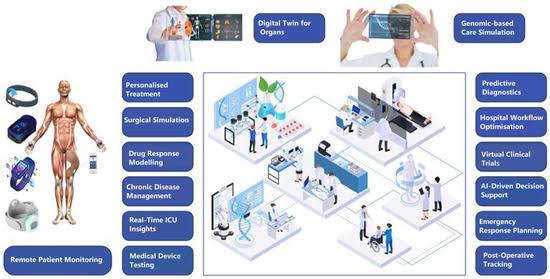
The Medical Digital Twin is becoming one of the most interesting concepts in healthcare technology in 2026. A digital twin is a computer-based representation of a real-world object, system, or process. In medicine, researchers and healthcare organizations are exploring how patient-specific digital models could combine medical images, physiological measurements, laboratory data, and other information to support more personalized care.
The vision behind the Medical Digital Twin is powerful: instead of relying only on population-level averages, healthcare professionals could use patient-specific models to explore possible scenarios before making certain decisions. These technologies are still developing, and a digital model cannot perfectly reproduce the complexity of a human body. Nevertheless, advances in artificial intelligence, medical imaging, simulation, and data analytics are creating new opportunities for personalized healthcare.
Table of Contents
- What Is a Medical Digital Twin?
- Personalized Patient Modeling
- Medical Digital Twin for Surgery
- Chronic Disease Management
- AI and Digital Twin Technology
- Medical Imaging and Virtual Simulation
- Challenges and Patient Privacy
- Future of Medical Digital Twin Technology
- Final Thoughts
What Is a Medical Digital Twin?
A Medical Digital Twin is a computational model designed to represent aspects of an individual patient’s anatomy, physiology, or health condition. Depending on the purpose, the model could represent an organ, cardiovascular system, tumor, or another biological process.
The concept is different from simply storing a patient’s medical records. A digital twin attempts to use available information to model how a physical system behaves or could respond under particular conditions.
For example, medical imaging could provide information about anatomy, while physiological measurements could add information about how that system functions. Advanced computational models can then be used to explore specific scenarios.
The level of detail depends heavily on the available data, modeling methods, and clinical application.
Personalized Patient Modeling
One of the biggest opportunities for the Medical Digital Twin is personalized healthcare. Traditional clinical research often depends on data collected from large populations. While this information is extremely valuable, individual patients can respond differently to the same treatment.
Patient-specific modeling attempts to account for some of these differences. A model could potentially combine information from medical imaging, laboratory tests, medical history, and monitoring devices to create a more individualized representation.
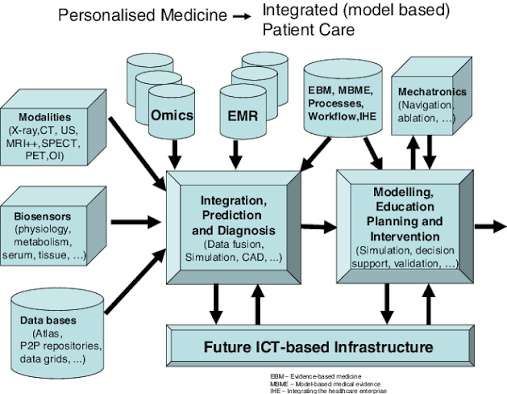
This does not mean that doctors will receive a perfect virtual copy of a person. Human biology is extremely complex, and many variables remain difficult to measure or predict.
Patient-Specific Data
The usefulness of a Medical Digital Twin depends on the quality of the information used to create it. Medical imaging can provide anatomical information, while sensors and laboratory tests can provide additional physiological measurements.
As healthcare becomes more connected, combining these different data sources could make patient-specific models increasingly sophisticated.
Medical Digital Twin for Surgery
Surgical planning is one of the most promising applications of the Medical Digital Twin concept. Three-dimensional models can already help clinicians understand complex anatomy, while advanced simulations may provide additional ways to plan procedures.
A patient-specific digital model could allow a medical team to examine anatomy from different perspectives and explore potential approaches before an actual procedure.
The idea of rehearsing an operation in a virtual environment is particularly attractive for complicated procedures. However, simulation results should support clinical judgment rather than replace the expertise of surgeons.
Virtual Surgical Planning
The Medical Digital Twin could potentially help doctors visualize difficult anatomical structures and understand relationships between organs, blood vessels, and other tissues.
In the future, increasingly sophisticated simulations could allow clinicians to compare different procedural scenarios. This could make planning more personalized while providing additional information before treatment.
The technology still requires rigorous validation before simulated outcomes can be treated as reliable predictions of what will happen during a real operation.
Chronic Disease Management
Another important area for the Medical Digital Twin is chronic disease management. Conditions such as diabetes and cardiovascular disease require continuous monitoring and individualized decisions.
A digital model could potentially combine information about a person’s physiology, lifestyle, medications, and historical measurements. Researchers are exploring how computational models can be used to simulate disease progression or treatment responses.
For diabetes, for example, digital modeling may eventually help researchers understand how different variables interact with glucose regulation. But the idea that a consumer can reliably simulate the exact effect of a meal or medication before taking it remains beyond what current digital-twin systems can guarantee.
Medical Digital Twin and Diabetes Research
The Medical Digital Twin concept could become particularly valuable when combined with continuous monitoring technologies. Glucose sensors, activity trackers, laboratory results, and other measurements can produce large datasets that may help researchers develop more individualized models.
These systems could eventually support decision-making by identifying patterns and testing hypothetical scenarios computationally. Medical treatment decisions, however, still require appropriate clinical evaluation.
AI and Digital Twin Technology
Artificial intelligence is an important component of modern Medical Digital Twin research. AI can process large datasets and identify relationships that may be difficult to detect manually.
Machine-learning systems can also assist with medical imaging, prediction models, pattern recognition, and simulation. When combined with a patient-specific digital model, these technologies may create a more dynamic approach to healthcare data.

The key challenge is validation. An AI model can produce an impressive prediction while still being wrong in an individual case. Healthcare applications therefore require careful testing, transparent evaluation, and appropriate clinical oversight.
AI-Powered Medical Simulation
AI could eventually help update digital models as new patient information becomes available. A model might change as laboratory results, imaging, wearable measurements, or other clinical data are added.
This could turn a static digital representation into a more continuously updated system. The quality of the result would still depend on the accuracy, completeness, and relevance of the underlying data.
Medical Imaging and Virtual Simulation
Medical imaging is central to many Medical Digital Twin applications because it can provide detailed information about a patient’s physical anatomy. Technologies such as CT, MRI, ultrasound, and other imaging methods can help construct three-dimensional representations.
When these models are combined with computational simulation, researchers can investigate how anatomical structures may behave under particular conditions.
The goal is not to recreate every molecule or cell in the human body. Instead, digital-twin systems are generally designed around a specific clinical question or physiological process.
From Images to Digital Models
A scan can provide the starting point for creating a patient-specific model. Software can process anatomical information and convert it into a digital representation that can be viewed, measured, or simulated.
As computing power and AI-based image analysis improve, the process of creating useful models may become faster and more automated.
Medical Digital Twin Challenges
Despite its potential, the Medical Digital Twin faces major challenges. Human biology is highly complex, and no model can perfectly capture every factor affecting a patient’s health.
Data quality is another major issue. Medical records may contain missing information, measurements can contain errors, and different healthcare systems may store information in incompatible formats.
Clinical validation is also essential. A model should demonstrate that it provides meaningful benefits before being relied upon for important medical decisions.
Privacy and Medical Data
A Medical Digital Twin can require highly sensitive information, including medical images, laboratory results, physiological measurements, and personal health history.
Protecting this information is therefore critical. Healthcare organizations need strong cybersecurity, appropriate access controls, responsible data governance, and clear policies regarding how patient information is used.
Patients should also understand whether their health data is being used for treatment, research, product development, or other purposes.
Medical Digital Twin Trends in 2026
| Trend | Main Technology | Potential Healthcare Use |
|---|---|---|
| Patient Modeling | AI + medical data | Personalized analysis |
| Surgical Simulation | 3D modeling | Procedure planning |
| Medical Imaging | CT, MRI, ultrasound | Anatomical modeling |
| Chronic Disease Models | AI + monitoring | Disease management research |
| Digital Physiology | Computational simulation | Treatment research |
| AI Integration | Machine learning | Pattern analysis |
| Data Security | Privacy technology | Patient protection |
Medical Digital Twin Growth Concept
The following conceptual graph shows how different healthcare data sources can contribute to a patient-specific digital model:
Medical Imaging ───────┐
                       │
Lab Results ───────────┤
                       │
Wearable Data ─────────┼──> Medical Digital Twin
                       │            │
Patient History ───────┤            ▼
                       │      AI + Simulation
                       │            │
                       └────────────▼
                         Clinical Insights
This is a conceptual workflow rather than a claim that current digital twins can perfectly predict individual medical outcomes.
Future of Medical Digital Twin Technology
The future of the Medical Digital Twin will likely depend on better data integration, stronger clinical validation, improved simulation methods, and responsible AI.
Instead of creating one enormous model of an entire human body, healthcare systems may develop specialized digital twins for specific organs, diseases, or clinical questions. This approach could make the technology more practical because models can be designed around clearly defined medical objectives.
Interoperability will also matter. A digital twin becomes more useful when relevant information can be safely collected from different healthcare systems and devices without creating unnecessary duplication.
Over time, digital twins could become another layer in clinical decision support, helping healthcare professionals analyze complex information and explore possible scenarios.
Final Thoughts
The Medical Digital Twin represents an ambitious direction for personalized healthcare. By combining medical imaging, physiological data, AI, and computational simulation, researchers are exploring ways to create patient-specific models that could support diagnosis, treatment planning, disease research, and monitoring.
The technology should not be viewed as a perfect virtual replica capable of predicting everything that will happen inside the human body. Its current value is better understood as an emerging modeling and decision-support approach.
As validation improves and healthcare data becomes more connected, the Medical Digital Twin could play an increasingly important role in moving healthcare toward more personalized and data-driven decision-making.
 administratoir16