
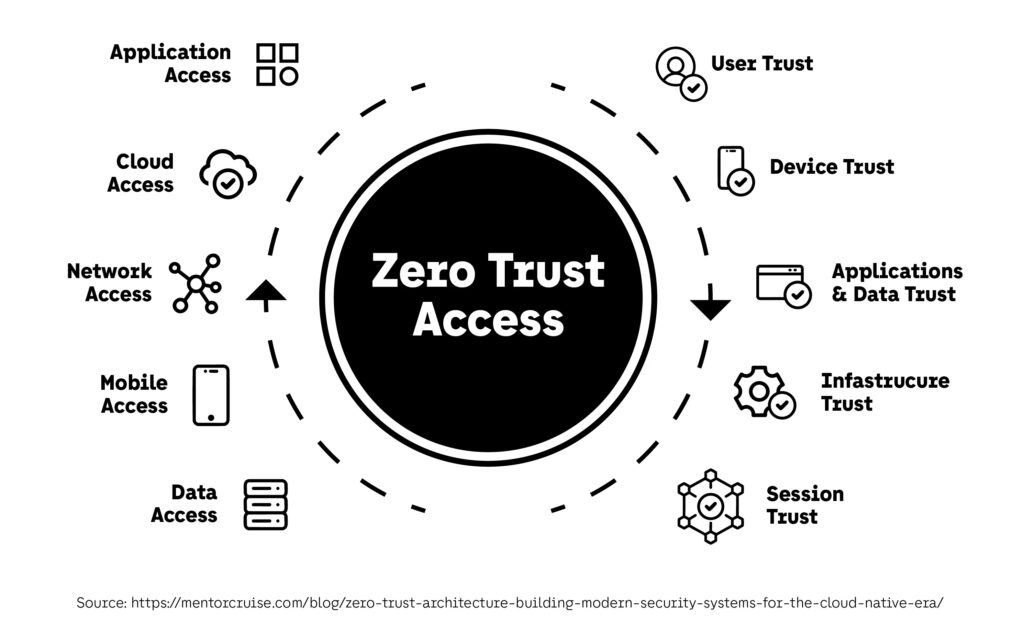
In 2026, Zero-Trust Architecture is becoming an increasingly important approach to protecting modern digital environments. Traditional network security often depended on a strong perimeter, but today organizations use cloud platforms, remote access, mobile devices, SaaS applications, and AI systems that can exist far beyond a single office network. NIST describes Zero Trust as an architecture that does not grant implicit trust based simply on network location or ownership and instead focuses on protecting users, devices, applications, data, and other resources.
The basic philosophy behind Zero-Trust Architecture is simple: access should be verified rather than automatically trusted. A user being inside an office network does not automatically mean that every application or resource should be available to that user. In modern environments, identity, device health, resource sensitivity, location, and behavior can all become part of an access decision Zero-Trust Trends.
Table of Contents: Zero-Trust Architecture 2026
This Zero-Trust Architecture guide covers the changing security perimeter, continuous verification, identity-based access, device security, AI-assisted security, application protection, data protection, implementation challenges, and the future of Zero Trust in 2026.
Zero-Trust Architecture 2026 and the End of the Old Security Perimeter
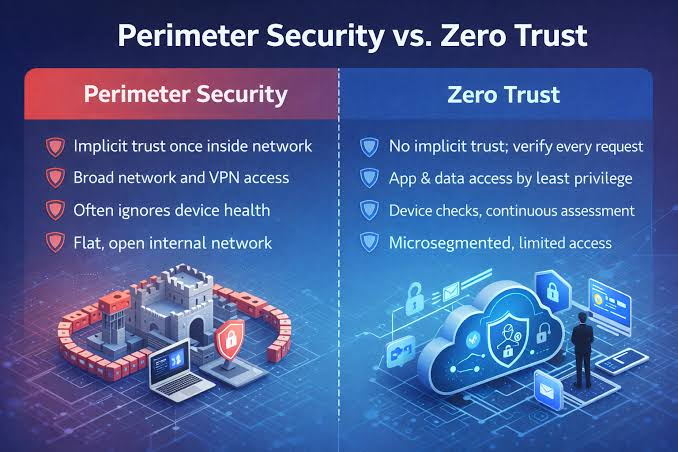
The traditional security model was built around the idea that an organization could create a strong boundary around its internal network. Employees inside that boundary were often treated as more trusted than people outside it. That approach becomes harder to maintain when employees work remotely, applications run in multiple clouds, and business data moves between different services Zero-Trust Trends.
Zero-Trust Architecture changes this model by moving the focus from the network perimeter to the individual resource being protected. NIST explains that Zero Trust does not assume implicit trust simply because a user or device is connected through a particular network location. Authentication and authorization are treated as separate security functions before access to enterprise resources is established.
This does not mean that firewalls or network security disappear. Instead, they become part of a larger security strategy where identity, endpoint protection, application controls, data security, and monitoring work together.
Zero-Trust Architecture 2026 Compared With Traditional Security
| Security Area | Traditional Perimeter Model | Zero-Trust Architecture |
|---|---|---|
| Network location | Often treated as a major trust signal | Not automatically trusted |
| User access | Trust may increase after network entry | Access is continuously evaluated |
| Device | Internal devices may receive broad access | Device health can influence access |
| Applications | Network location can control access | Application and resource access is controlled |
| Data | Often protected behind network boundaries | Protection follows the data and resource |
| Remote work | Can require additional perimeter tools | Designed for access from different locations |
| AI systems | Often handled separately | Can be incorporated into Zero Trust controls |
The important difference is that Zero-Trust Architecture treats access as something that must be justified rather than something automatically granted.
Zero-Trust Architecture 2026 and Continuous Verification
One of the most important ideas behind Zero-Trust Architecture is continuous verification. Authentication at the beginning of a session may not be enough when circumstances change during that session.
NIST’s implementation guidance describes real-time, continuous, policy-driven and risk-based assessment for maintaining access. The factors considered can include identity, role, device health, credentials, resource sensitivity, location, and behavioral consistency Zero-Trust Trends.

Imagine an employee normally accessing a small number of business documents during working hours. Suddenly, the same account begins accessing sensitive files from an unfamiliar device and an unusual location. A Zero Trust system can treat those changes as additional signals instead of assuming the original login proves that everything is safe.
This is where modern security monitoring becomes important. Rather than simply asking whether the password was correct, the system can evaluate whether the complete access request makes sense according to the organization’s security policies Zero-Trust Trends.
Zero-Trust Architecture 2026 and AI-Powered Behavior Detection
Artificial intelligence is adding another layer to Zero-Trust Architecture by helping security systems analyze large amounts of activity. Modern organizations can generate enormous volumes of authentication, device, application, and network data, making manual analysis difficult Zero-Trust Trends.
AI and machine-learning systems can help identify unusual patterns and highlight activity that deserves additional investigation. For example, an account that suddenly behaves very differently from its normal pattern may trigger additional verification or a security response.
However, AI should not be treated as a magical security solution. Behavioral analysis can produce false positives, and unusual activity is not automatically malicious. A legitimate employee may travel, change devices, work unusual hours, or access a large amount of data because of a genuine business requirement Zero-Trust Trends .
The more useful approach is to combine behavioral signals with identity, device, application, and data controls. Microsoft’s 2026 Zero Trust guidance for AI emphasizes continuously evaluating the identity and behavior of AI agents, workloads, and users while applying least privilege and assuming that attacks can occur Zero-Trust Trends.
Zero-Trust Architecture 2026 Behavioral Verification Flow
The conceptual security flow can be understood like this Zero-Trust Trends.
User or AI Agent → Identity Verification → Device & Context Check → Risk Analysis → Policy Decision → Limited Resource Access → Continuous Monitoring → Re-Verification
This is not a statistical graph; it is a simplified representation of how continuous verification can operate inside a modern Zero Trust environment Zero-Trust Trends.
Zero-Trust Architecture 2026 and Identity-Based Security
Identity has become one of the central components of Zero-Trust Architecture because users and automated systems may access resources from many different locations and devices.

Instead of relying mainly on an internal IP address or office network, organizations can make access decisions using identity and authorization policies. This can include a user’s role, authentication strength, device condition, resource sensitivity, and other contextual signals.
Least privilege is especially important here. A user should receive only the access required to perform a legitimate task instead of automatically receiving broad access to an entire network Zero-Trust Trends.
This approach can also help reduce the potential impact of compromised accounts. If an attacker obtains valid credentials, strong Zero Trust controls can still limit what the account can access.
Zero-Trust Architecture 2026 and Device Security
A legitimate username does not necessarily mean the device being used is safe. A compromised laptop, unmanaged smartphone, or outdated endpoint can become a significant security risk.
For this reason, Zero-Trust Architecture can evaluate device-related signals before allowing access to sensitive resources. Device health, security configuration, credentials, and compliance status can become part of the decision-making process Zero-Trust Trends.
This becomes particularly important in hybrid work environments where employees may connect from homes, offices, hotels, coworking spaces, or other locations. NIST’s recent ZTA guidance specifically addresses enterprise resources distributed across on-premises and multiple cloud environments while supporting hybrid workers and partners accessing resources from different locations and devices Zero-Trust Trends.
Zero-Trust Architecture 2026 and Application Security
Modern applications are another reason the old perimeter concept is becoming less useful. Businesses may rely on SaaS products, cloud applications, custom software, APIs, containers, and services distributed across different environments.
Zero-Trust Architecture focuses on protecting resources rather than assuming that everything inside one network is automatically safe. This means application access can be controlled according to identity, permissions, resource sensitivity, and security policy.
NIST’s 2025 implementation guide includes technologies and concepts such as identity governance, identity and access management, microsegmentation, secure access service edge, and software-defined perimeter as part of practical ZTA implementations Zero-Trust Trends.
For developers and security teams, this means security controls increasingly need to be integrated into application architecture rather than added only at the outer network boundary Zero-Trust Trends.
Zero-Trust Architecture 2026 and Data Protection
Data is ultimately one of the most important assets that Zero-Trust Architecture is designed to protect. If an attacker compromises an account, preventing access to unnecessary sensitive information can limit the potential damage.
A Zero Trust strategy can connect access policies to the sensitivity of a resource. Ordinary information may require fewer controls, while confidential business data can require stronger authentication, healthier devices, additional authorization, or other security checks.
Data protection also becomes increasingly important as organizations adopt AI. AI applications may interact with business documents, databases, APIs, and other sensitive resources. Microsoft’s 2026 Zero Trust for AI guidance highlights the need to apply least privilege to models, prompts, plugins, and data sources.
Zero-Trust Architecture 2026 Implementation Challenges
Although Zero-Trust Architecture offers a modern security model, implementing it is not simply a matter of installing one security product. Organizations often have legacy applications, outdated identity systems, complicated permissions, multiple cloud environments, and different security tools Zero-Trust Trends.
A successful implementation therefore usually requires planning and gradual modernization. Organizations need to understand which resources are most important, who needs access to them, what devices are being used, and which security signals should influence access decisions.
NIST’s finalized SP 1800-35 provides 19 example Zero Trust implementations designed with commercially available technologies. These examples demonstrate that Zero Trust can be implemented through different combinations of technologies rather than through one universal product or configuration Zero-Trust Trends.
Zero-Trust Architecture 2026 and the Future of Digital Security
The future of Zero-Trust Architecture is likely to involve increasingly connected security controls across identity, endpoints, applications, networks, data, and AI systems. Microsoft’s 2026 Cybersecurity Reference Architecture updates specifically expanded its treatment of AI alongside existing Zero Trust security architecture.
The concept is also moving beyond protecting only human users. AI agents and automated workloads can now perform tasks, interact with data, and communicate with other systems. This creates new trust boundaries that require authentication, authorization, monitoring, and least-privilege controls Zero-Trust Trends.
The future security model is therefore less about building one massive wall around a corporate network and more about creating multiple intelligent controls around individual users, devices, applications, workloads, and data.
Zero-Trust Architecture 2026: Final Thoughts
Zero-Trust Architecture represents a major shift in how organizations think about digital security. Instead of assuming that a user or device is safe because it is already inside a trusted network, Zero Trust treats every access request as something that should be evaluated according to identity, context, policy, and risk.
In 2026, this approach is especially relevant because organizations operate across cloud platforms, remote environments, SaaS applications, mobile devices, and increasingly AI-powered systems. NIST’s current implementation guidance shows practical ways to build Zero Trust environments, while newer AI-focused guidance demonstrates how the same principles are being extended to AI agents and workloads Zero-Trust Trends.
The biggest change is not simply a new security tool. It is a change in mindset. Security increasingly follows the user, device, application, workload, and data instead of depending on a single network boundary. For organizations looking for a modern and adaptable security strategy, Zero-Trust Architecture provides a framework for continuously verifying access while reducing unnecessary trust.
Zero-Trust Architecture 2026 Key Takeaway
The modern security question is no longer simply, “Are you inside the network?” It is becoming, “Who are you, what are you using, what are you trying to access, and does the current context justify that access?” That shift is at the heart of Zero-Trust Architecture.
 administratoir16